
Intel’s Stock: Trading Below Tangible Book Value—What’s Going On?
Disclaimer
Up-Education is not a financial advisor. All information provided is for educational purposes only. Always consult with a certified financial professional before making any investment decisions. The views expressed here are solely our own and should not be interpreted as financial advice or a recommendation to make any specific investment decisions. Use this information at your own discretion and responsibility.
You should not make buying or selling decisions based on this post or any other information from Up-Education.
Intel Trading Below Tangible Book Value
Isn’t it interesting to see a major tech giant like Intel trading below its tangible book value? Tangible book value represents the value shareholders could theoretically receive if the company were to liquidate its assets and pay off all liabilities. Essentially, it’s a measure of a company’s hard assets, excluding intangible assets like goodwill.
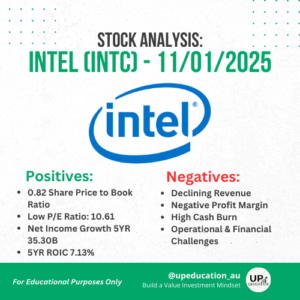
As of early 2025, Intel’s stock price has dropped significantly, leading to a price-to-book (PB) ratio of 0.82, meaning its market valuation is below the value of its tangible assets—a rare situation for a company of Intel’s size and industry status. This could potentially signal that the stock is undervalued, making it an interesting prospect for value investors.
What Is Tangible Book Value?
Tangible book value per share is calculated by subtracting intangible assets and liabilities from total equity, then dividing by the number of shares outstanding. It provides a conservative estimate of a company’s worth.
Intel’s tangible book value has steadily grown over the past decade, as shown in the chart above. However, after a significant drop in its stock price, Intel is now trading at a price that implies the market values it below its net tangible assets—a potential opportunity for value investors who are willing to take on some risk.
Analyzing the Stock Chart
Looking closely at the chart, we can highlight a few key events:
- 2020 Drop: The significant drop in Intel’s stock price around early 2020 correlates with the global COVID-19 pandemic, which caused market-wide volatility and disruptions in supply chains.
- Recent Decline: The stock faced another major decline in late 2024 and early 2025. This may be attributed to increasing competition, declining market share, and underwhelming product performance in the past few years, as Intel struggled to match AMD’s and Qualcomm’s innovations.
Despite these drops, Intel has shown resilience by steadily increasing its tangible book value per share over the long term, suggesting that the company continues to strengthen its asset base even in difficult times.
Positives and Negatives About Intel
Positives
- Potentially Undervalued – Trading at 0.82 Price-to-Book Ratio
- Intel’s PB ratio of 0.82 suggests that the market is currently valuing the company below its tangible book value, which may indicate that the stock is undervalued. This could present a buying opportunity for value-focused investors.
- 5-Year P/E Ratio (10.61)
- Intel’s 5-year average P/E ratio is relatively low, which further supports the idea that the stock may be undervalued relative to its historical performance.
- Dividend Yield (2.59%)
- Intel offers a reasonable dividend yield of 2.59%, making it attractive to investors seeking income. The forward dividend yield is also 2.52%, suggesting consistent shareholder returns.
- Steady Book Value Growth
- Despite recent struggles, Intel has achieved a 5-year compound book value growth rate of 6.04%, showing that it has been able to grow its tangible equity over time.
- Price-to-Sales Ratio (1.51)
- Intel’s price-to-sales ratio of 1.51 is relatively low, implying that the stock is inexpensive relative to its revenue.
- Gross Profit Margin (34.67%)
- Intel’s gross profit margin of 34.67% indicates that, despite current net losses, the company’s core business operations still have potential profitability.
Negatives
- Net Income and Profit Margin
- Intel reported a negative net income (-$15.96B) and a profit margin of -29.42%, indicating that the company is currently incurring significant losses.
- Declining Revenue Growth
- Over the past 5 years, Intel’s revenue has declined by -16.17B, and its 3-year compound revenue growth is -11.58%, signaling a challenging business environment and loss of market share.
- Negative Free Cash Flow
- Intel has a negative free cash flow of -$15.06B over the trailing twelve months (TTM), and its 5-year average free cash flow is -$224.60M, indicating that the company is burning cash rather than generating it.
- High Debt Levels
- Intel’s long-term liabilities relative to its free cash flow are high, as indicated by the warning that its LTL/5-year FCF ratio is not allowed due to negative cash flow, suggesting potential balance sheet concerns.
- Poor Return Metrics
- Intel’s return on assets (-8.14%), return on equity (-16.04%), and return on invested capital (0.01%) are all poor, highlighting inefficiencies in generating returns from its assets and investments.
- Moving Averages Below Current Price
- Intel’s current stock price is below its 25-day, 50-day, 100-day, and 200-day moving averages, indicating a bearish trend in the market.
- Price Volatility
- Intel’s 52-week high ($50.30) and 52-week low ($18.51) reflect significant volatility, which could deter risk-averse investors.
Intel Launches Powerful Laptop Chips to Reclaim Market Share
Key Points
- Introduction of Arrow Lake Chips
Intel recently launched its Arrow Lake chips for laptops, focusing on both performance and energy efficiency. The new chips fill a gap in Intel’s lineup, offering an upgrade over its previous Lunar Lake and Meteor Lake CPUs. - Performance vs. Efficiency
While Intel’s earlier Meteor Lake and Lunar Lake families emphasized efficiency and AI capabilities, Arrow Lake brings significant improvements in raw performance. This is crucial as Intel looks to appeal to enthusiasts and gamers who demand high-performance CPUs. - Core Count and Architecture
The new Arrow Lake chips boast up to 24 cores (8 performance cores and 16 efficiency cores) in the top-tier models, making them well-suited for both single-threaded and multi-threaded workloads. Additionally, Intel has outsourced manufacturing of these chips to TSMC to ensure high efficiency and quality. - Potential PC Refresh Cycle
With Windows 10 support ending in October 2025, a potential PC upgrade cycle could be on the horizon. Businesses and consumers will need newer hardware to run Windows 11 efficiently. Intel, with its latest Arrow Lake and Lunar Lake chips, is well-positioned to benefit from this anticipated surge in demand.
Final Thoughts
Intel’s current situation presents a complex picture. On one hand, the company faces tough competition, declining revenues, and operational challenges. On the other hand, its consistent growth in tangible book value, strong dividend yield, and new product launches could provide a solid foundation for future recovery.
Value investors might view Intel’s low price-to-book ratio as an opportunity, while tech enthusiasts will be keen to see how Intel’s new chips perform against AMD and Qualcomm in the coming months.

Source: