
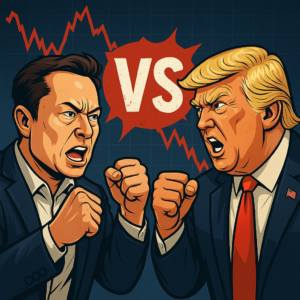
It started like a bad breakup and ended with a bloodbath on the stock market. Donald Trump and Elon Musk, once political allies and mutual admirers, are now at war—and their very public feud just cost Tesla nearly $200 billion in value.
But this fight isn’t just about bruised egos and outrageous tweets. It’s exposing something much darker underneath: the fragility of investor confidence, the power of narrative over numbers, and a U.S. debt crisis that could soon downgrade America’s credit rating.
Let’s dive into the spectacle, the fallout, and what it means for investors like us.
💥 The Billionaire Brawl: How It All Exploded
Just a few months ago, Trump and Musk were two titans on the same team. Musk was cozying up to Trump’s 2024 campaign and even advising on government tech reform. Fast forward to June 2025—and it’s all gone nuclear.
Here’s how it unfolded:
- Musk accused Trump of concealing Epstein-related documents, even implying Trump might be implicated himself.
- In retaliation, Trump tweeted that the easiest way to cut the U.S. budget was to terminate Musk’s $2 billion in government subsidies, saying “I was surprised Biden didn’t already do it.”
- Musk clapped back, calling Trump’s new legislative plan—the so-called “One Big Beautiful Bill”—a “disgusting abomination” that adds trillions to the national debt.
Within hours, Tesla shares tanked, social media lit up, and analysts began questioning whether this could spill into broader market turmoil.
This wasn’t just political theatre—it was a market-moving moment.
📉 Tesla Takes the First Hit: $200 Billion Wiped Out
The impact was immediate:
- Tesla’s stock plummeted 14% in a single day, and over 20% across the week.
- That’s more than $200 billion in lost market value—gone over what’s essentially a Twitter spat.
- It marked the biggest one-week drop in Tesla’s history since 2020.
But the fundamentals of the business didn’t change. No product recalls. No earnings revisions. No major factory closures.
So why did it crash?
Because markets run on trust, momentum, and narrative—and when Musk’s public persona takes a hit, Tesla’s stock suffers, regardless of its revenue growth or production capacity.
💣 The Bigger Threat: U.S. Debt and a Credit Downgrade
While the Musk–Trump clash made headlines, the bigger danger is the one barely making the evening news: the rising risk of a U.S. credit downgrade.
Trump’s “One Big Beautiful Bill” promises:
- Permanent 2017-style tax cuts,
- Elimination of taxes on tips and overtime,
- Increased spending on immigration enforcement and military.
It’s a populist plan with a heavy price tag—$2.4 trillion in new debt over the next decade.
The U.S. national debt has already hit $36.2 trillion, and rating agencies are beginning to worry. A downgrade from AAA to AA, as some analysts are warning, could:
- Raise interest rates across the board,
- Weaken the U.S. dollar globally,
- Cause widespread volatility across equity and bond markets,
- And shake investor confidence at the deepest level.
If this sounds familiar, it should: in 2011, S&P downgraded U.S. debt, and the markets responded with weeks of instability and loss.
⚡ Tesla’s Numbers: Still Strong, But Sentiment is King
Ironically, Tesla’s fundamentals are better than ever:
- Revenue nearly doubled in the last four years.
- Profitability remains stable.
- Expansion in energy storage, semi trucks, and robotaxis continues.
But none of that matters when the CEO becomes the story.
Musk’s transformation from genius innovator to political lightning rod has eroded his investor halo. What used to be a premium on his visionary leadership is now turning into a reputational discount. Investors are starting to ask: Is Tesla still a tech stock? Or just a volatile car company with an unpredictable figurehead?
And when public perception shifts, so does valuation.
📚 Investor Lessons: Valuation, Margin of Safety, and Independent Thinking
There’s a powerful takeaway here—not just about Tesla, but investing in general:
- A great company can still be a bad investment if you overpay.
- Charismatic leaders are not bulletproof. They can fall from grace quickly.
- Valuation and fundamentals matter more than hype.
- A margin of safety is non-negotiable. When $200 billion can vanish over a feud, you better not be hanging by a thread.
Too many investors bought Tesla purely because they believed in Musk. That’s fine—until Musk becomes the reason it crashes.
The lesson? Never invest in a person. Invest in a business.
🔮 What Happens Next?
The Musk–Trump saga isn’t over. They might reconcile tomorrow—or escalate further. Tesla may bounce back—or keep sliding.
But the real storm cloud is structural: America’s addiction to debt, and the growing risk that the world’s largest economy may no longer be viewed as a perfect borrower.
If the U.S. gets downgraded from AAA to AA, the damage will make the Musk–Trump feud look like a sideshow.
If this post resonates with you, follow UP-Education for more
Disclaimer: This blog is for educational purposes only and does not constitute financial advice. Please consult a licensed financial professional before making any investment decisions.